Learning to See from Metamorfoblus
A note from the Documentary Film Screening and Discussion
By:
Dr. Ida Bagus Gede Surya Peradantha, M.Sn.
E-mail:
Peradantha@outlook.com
That morning, August 14 2026, I had the opportunity to watch Dosy Omar's Metamorfoblus, assisted by Beck as an editor at ISBI Campus I Tanah Papua. The screening took place from 10.00 to 12.00 WIT and was followed by a conversation with the creator. As a dance lecturer who teaches Dance Criticism, my attention while watching actually moves to the problem that I often face with students: where does creativity actually start?
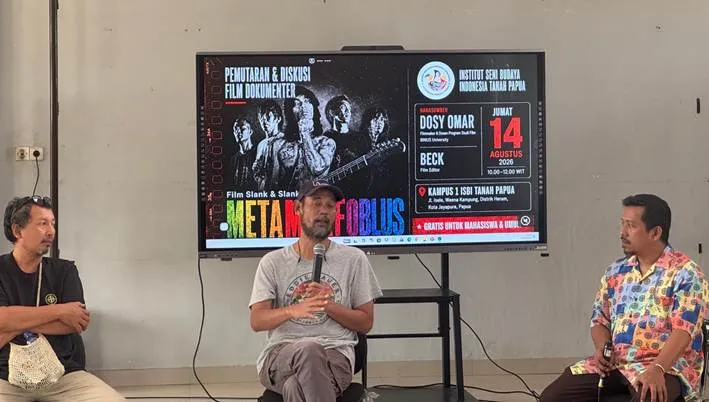
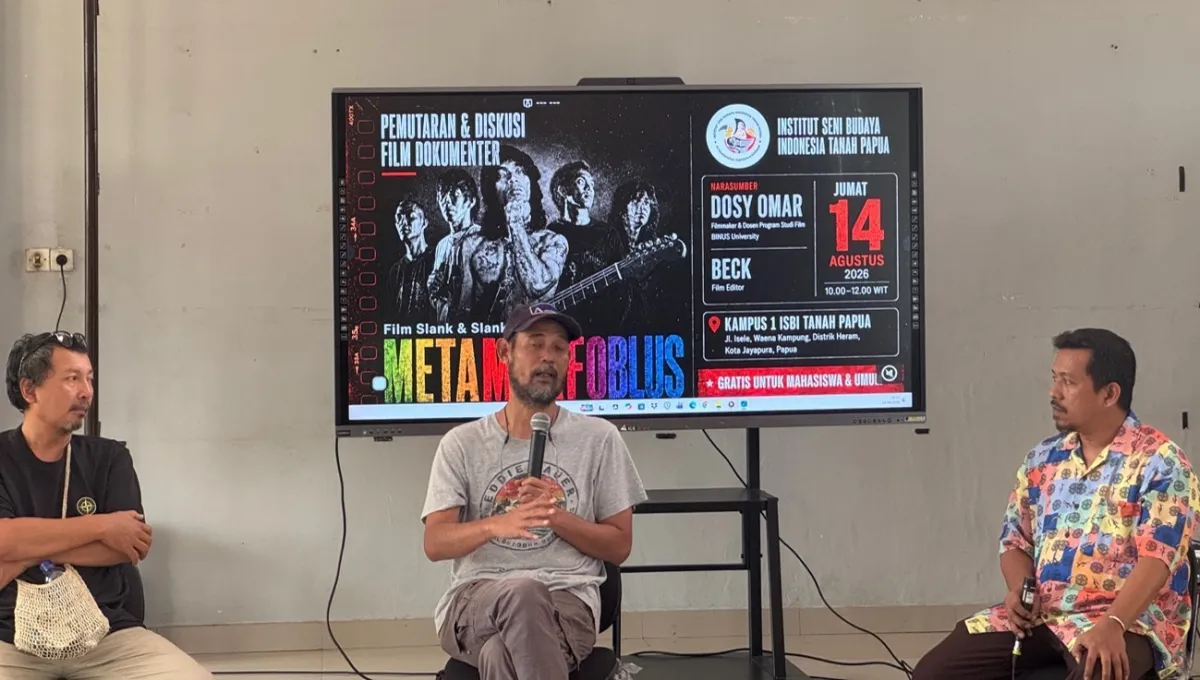
Figure 1: Dosy Omar (center) and Beck (left) guided by ISBI Tanah Papua lecturer, M. Ilham Murda (right), share the creative process behind Metamorfoblus in a film screening and discussion session at Campus I ISBI Tanah Papua, 14 August 2026.
Photo: author's documentation.
When Slank is No Longer the Center of the Story
Metamorfoblus departs from Slank, but this film does not choose the easy path by making Slank the center of the story. The camera moves to the Slankers and the life that forms around the music. We meet people from different places and life experiences. There is Joker in Batam, a policeman with an appearance that is far from the stereotype of police in general. There is Andi Virus in Bantul with his family experiences and struggles with drugs. The story moves to Kupang and touches on the relationship between Indonesia and Timor-Leste through fans of the band Slank. Based on the lives of fans of a music group, the film then talks about violence, drugs, family, brotherhood, peace and change. That's where for me Metamorfoblus gets smart.
Imagine if the filmmakers from the start just thought, "I'm going to make a film about Slank." The camera can follow the concert, go backstage,
interviewing personnel, opening archives, then compiling the journey of a large musical group. Such films are still legal. But Dosy discovered something further. He saw that interesting stories actually lived in the humans who came into contact with Slank.
Slank finally became the entry point for human reading. How to find stories like this becomes even more interesting when in the discussion Dosy says that he doesn't always understand research as a formal activity that must start with a complete design. He talked about sitting in coffee shops, listening to conversations, watching people and observing phenomena that occurred. From there ideas can emerge. For me, what he does is still a research process. Perhaps the form is different from academic research which is familiar with proposals, instruments, structured interviews, and a series of methodological procedures. However, there are activities of observing, listening, finding patterns, asking questions, then making decisions based on what is found
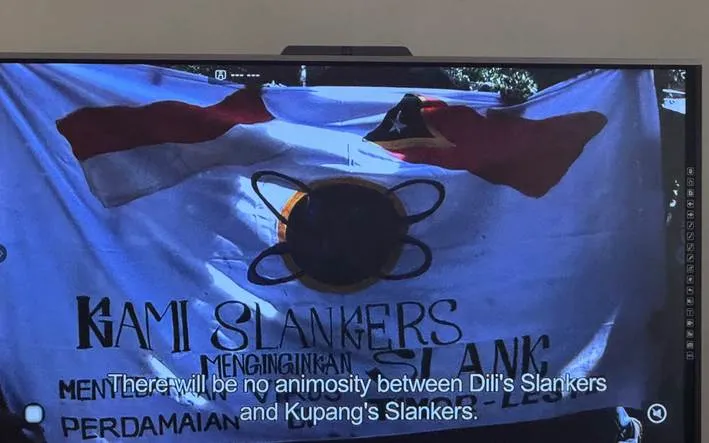
Figure 2. Footage of Metamorfoblus showing the message of peace between Slankers Kupang and Dili. The film brings the story of music fans to broader issues about brotherhood, boundaries and peace.
Photo: author's documentation.
Cameras that Participate in "Searching"
This way of finding stories becomes even more interesting when in the discussion Beck, the editor, says that he does not always understand research as a formal activity that must start with a complete design. He talked about sitting in coffee shops, listening to conversations, watching people and observing phenomena that occurred. From there ideas can emerge.
For me, such activities still have a research character. There is a process of observing, listening, finding something, questioning it, then making a decision based on what is found. In visual studies, this kind of understanding is not something strange. Fitzgerald and Lowe (2020) even position documentary filmmaking as a research process that can involve data collection and meaning formation, not just an audiovisual product created after the research is complete. Beck uses an interesting phrase: research with camera, instead of research for camera.
I understand research for camera from the explanation as a state when the filmmaker has prepared what he wants to find. The idea, message, and even the need for the image are determined in advance. The field then becomes a place
find out what is needed to fulfill the plan. Research with camera offers a different attitude. A camera was brought along to join the search. Filmmakers enter the field with a willingness to see what really happens, including accepting the possibility that reality may offer a different story than they initially imagined.
This way of thinking is close to the area of ??visual ethnography discussed by Sarah Pink (2021), when visual practices are positioned as part of the process of producing knowledge and meaning. The camera thus does not have to wait until the knowledge has been formulated. Through its use, something can actually be discovered, questioned and then understood. I like this idea because it positions the camera as more than just a recording device. The camera also becomes a tool for thinking.
Learning from a Belt
One of the most powerful examples comes at the start of Metamorfoblus. There is a scene where concertgoers are asked to remove their belts before entering. At first glance this may just be a security check procedure. However, Dosy captured something odd and important from this incident. In the discussion he explained that the belt was removed because it could be used as a weapon during a riot. Such ordinary objects suddenly have another meaning.
Dosy doesn't need to open the film with a long description of the potential for violence at concerts. It shows people taking off their belts. The scene works because there is a sensitivity and artistic decision behind it. Of the many events in the field, filmmakers must be able to recognize which ones just pass by in front of the camera and which ones have the power to tell the story. This kind of work is close to what David MacDougall (2020) calls observational filmmaking, especially in the filmmaker's openness to spontaneous human behavior and the filmmaker's position as observer. But observation alone is not enough. Dosy still had to determine that the event of removing the belt was worthy of being recorded, retained in the editing process, and then placed at the beginning of the film. That's where artistic decisions become important.
Many people may look at the belt. Creators see the problem behind the belt. For me, the sequence is interesting: a phenomenon is discovered through observation, sensitivity makes us realize that the phenomenon is important, creativity reads its possible meaning, then artistic decisions determine how the discovery presents itself as a work. This kind of lesson feels important for ISBI Tanah Papua students.
We live in Papua with extraordinary cultural riches. There is dance, music, noken, tifa, boats, lakes, forests, language, folklore, rituals, villages and urban life that are constantly changing. This wealth provides almost inexhaustible material for creation. However, the closeness to all of this sometimes makes us feel too quickly that we have found something just because we have found the object. Dance students discover traditions and then take their movement motifs. Music students find songs and then make arrangements. Film students came to the village and recorded community activities. Fine arts students discover traditional motifs and then process them into new visual forms. All of that could be a start. The question is, what do we see further from there?
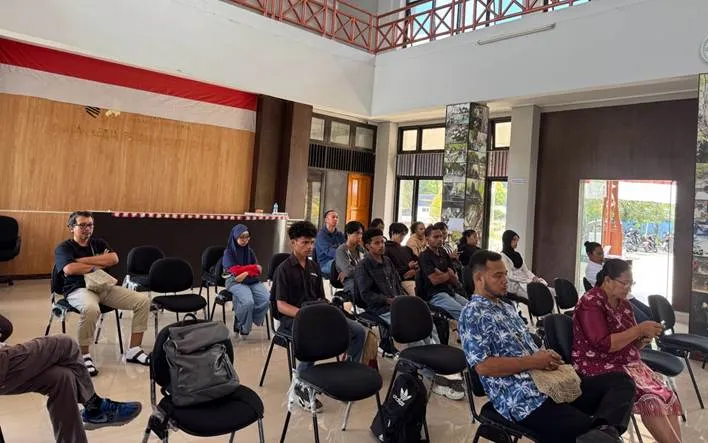
Figure 3. Lecturers and students of ISBI Tanah Papua attend the screening of Metamorfoblus at Campus I ISBI Tanah Papua. It is from this kind of viewing space that films can develop into material for learning to read reality and discover ideas.
Photo: author's documentation.
Metamorfoblus reminds me that objects are not necessarily stories. For example, students want to make a film about Lake Sentani. He can come up with ideas about environmental damage. Before going into the field, he had decided that there should be pictures of rubbish, community interviews, fish that were increasingly difficult to find, then a panorama of the lake with music that builds sadness. At some point, he may actually be busy looking for a reality that fits the finished film in his head. What if the method is reversed?
Come to Lake Sentani, for example. Sit with the people who live there. Listen to their conversation. Follow the activity. Pay attention to what is happening on the shore of the lake. Don't be too quick to determine what to find. It may be that students find a child throwing a mineral water bottle into a lake while his grandmother is telling him that the lake was part of the life of his ancestors. That small incident may be much more powerful than dozens of deliberately searched trash images. That is the "belt" that students must find.
The same principle can work in dance. Students who want to create a work from a traditional dance should not rush to look for movement motifs to transfer to the stage. Stay longer with the people dancing the dance. Who's still dancing? Who has stopped? What was discussed before they danced? Why are the younger generation attracted or turned away? What has changed about their bodies? What happens when the show is over? It may be that the most powerful source of choreography is not the movement motif, but rather the human problems found behind the movement.
This thought reminds me of a student's question towards the end of the semester. "Sir, what do I want to write a thesis about in the seventh semester?" I once answered by distinguishing between a music thesis and a thesis that was just about music. The principle also applies to dance, film, fine arts and other branches of art. Writing that is simply about music easily stops at notifications. What music is played, who the performers are, where it comes from, what instruments are used, when it is performed. Information like this is still useful, especially for cultural practices that have not been documented. But research needs to move when students want to produce deeper understanding.
Therefore, the question that I think is more important is: what problem do you want to understand through that music?
In the creation of the questions can be similar. What issues do you want to talk about through dance? What do you want to discover through film? What are you asking about through your craft? What is really going on behind the object that attracts your attention? From Metamorfoblus and the conversation with Dosy Omar that day, I increasingly believe that creativity is not a matter of making something strange to make it look different. Creativity requires sensitivity to see possibilities in things that to others may seem ordinary. Therefore, research for art students should not be understood as merely an activity of looking for references before creating a work. Read important books. Read important journals. Interviews are also important. But an artist needs to have another ability that is just as important: reading life. Sitting in a coffee shop and listening to conversations can be part of the research. Walking in the village can be research. Following people at work, watching children play, hearing mothers talking at the market, noticing changes in the sounds of a village, or recording something we don't yet understand can open the way to ideas. The condition is one: we are present with attention.
That's where I found the most important lesson from Metamorfoblus for ISBI Tanah Papua students. Papua has no shortage of objects to create or research. What we need to continue to practice is the ability to see the problem behind the object. Don't let Papua's riches stop being landscapes, motifs, ornaments or exotica that continue to be reproduced. Stay a little longer. Listen. Observe. Ask. Don't rush into thinking you already know what you'll find. Because sometimes a big idea doesn't come from something spectacular. He's probably waiting at the coffee shop. Or hidden in a belt that is removed before people enter the concert.
Reference
Fitzgerald, A., & Lowe, M. (2020). Acknowledging Documentary Filmmaking as not Only an Output but a Research Process: A Case for Quality Research Practice. International Journal of Qualitative Methods, 19. https://doi.org/10.1177/1609406920957462
MacDougall, D. (2020). Observational Filmmaking: A Unique Practice. Visual Anthropology, 33(5), 452–458. https://doi.org/10.1080/08949468.2020.1824976
Pink, S. (2021). Doing Visual Ethnography. SAGE Publications Ltd. https://doi.org/10.4135/9781036232306
The author is a lecturer in the Dance Study Program, Performing Arts Department, ISBI Tanah Papua. One of the courses he teaches is the Dance Criticism course and focuses on performing arts criticism, dance studies, and the relationship between art and social and cultural issues.
Masukkan email Anda untuk menerima brosur dan pengingat jadwal pendaftaran.
 ID
 EN